
Background

The Florida National Scenic Trail (FNST) is one of 11 National Scenic Trails in the US. It stretches over 1000 miles through a variety of Florida’s ecosystems. The University of Florida’s School of Forest, Fisheries, and Geomatics Sciences (SFFGS) began a collaborative visitor assessment project for the FNST with the U.S. Forest Service (USFS) and the Florida Trail Association (FTA) in June of 2003. The purpose of the study is to determine reliable use estimates of annual trail visits to the segments of the FNST. Our project assesses who are the people who use the trail, with the main question – how many?
2024-2025 Study Sites
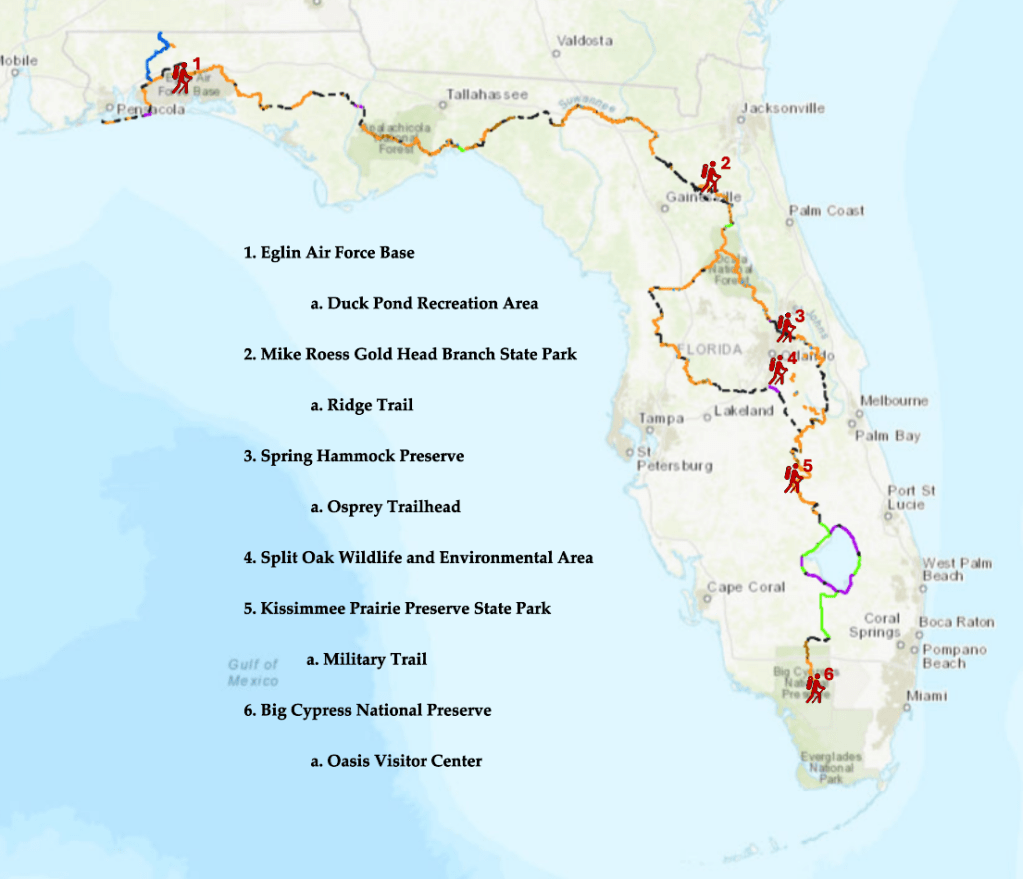
- Eglin Air Force Base – Duck Pond Recreation Area
- Mike Roess Gold Head Branch State Park – Ridge Trail
- Spring Hammock Preserve – Osprey Trailhead
- Split Oak Wildlife and Environmental Area
- Kissimmee Prairie Preserve State Park – Military Trail
- Big Cypress National Preserve – Oasis Visitor Center
Previous Years Results
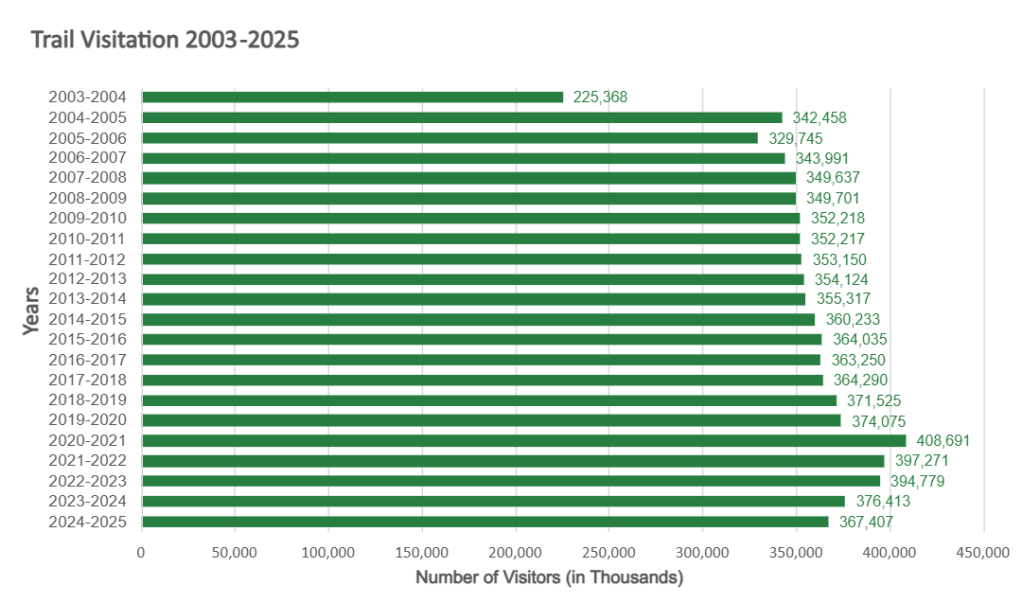
The 2024-2025 study year had the fifth highest estimated visits to the Florida Trail to date with an estimated 367,407 visitors. The 2020-2021 study year, however, had the highest estimated visits to the FNST, at 408,691 visitors. This was likely correlated to increased outdoor recreation seen across the country (and internationally) due to COVID-19 restrictions and work-from-home orders, among other societal changes (Fernandez et al., 2021; Rice et al., 2020).
Scope of Work
Needs Assessment
Work with FNST stakeholders (e.g., the National Forest in Florida’s FNST coordinator, the FNST Coalition, and Florida Trail Association representatives) to identify priority visitor assessments needs throughout the scope of the study.
Specific tasks will focus on measuring the impacts and outcomes of recreation management along the trail in terms of visitor use. Specifically, this project will measure the change in visitation as they relate to use of new trail routes, implementation of different marketing and promotional materials, improvements and changes to trail design, and management of surrounding natural resources
Data Collection
Several different types of data will be collected, using a combination of techniques, including mechanical counters, observation, and registration sheets. UF staffs’ primary efforts will focus on estimating the total number of people using the trail, but methods will vary to best measure impacts and outcomes associated with changes to trail promotion and management.
In addition to overall use estimates, information about the visitors will also be collected through on-site questionnaires and will measure impacts and outcomes beyond visitor use numbers. These questionnaires will collect information related to visitor satisfaction, management preferences, visitor attitudes, and socio-demographic characteristics. The questionnaires will be designed to be altered based on questions the USFS or FTA might have
Data Analysis
UF staff will clean and analyze visitor counter data to ensure reliable estimates are made for trail sections where visitor counters are installed. For visitor surveys, staff will mostly conduct descriptive statistics on the data collected. Inferential statistics will be used to better understand larger groups of users.
Reporting
Annually and upon request, UF staff will submit the data collected, results of the data analysis, and an interpretation of those results to the U.S. Forest Service. As the sponsor of this project, the USFS, will define specific products; however, results will be used for stakeholder engagement for all FNST partners, which include local, state, and federal land management agencies, recreation and environmental user groups, and tourism professionals.
Contact
tstein@ufl.edu
352-846-0860
 Recreation, Ecotourism, and Conservation Lab